
Warehouses and industrial buildings in San Antonio, Texas
A metal warehouse is a pre-engineered steel building sized around what moves through it: the span across the floor, the height at the eave, and the doors the trucks use. An independent local metal building contractor serving the San Antonio area prices it and puts it up.
Read the rest
The steel rarely sets the schedule here. The permit path, the pad and the power do.
- Sheet
- Service
- Jurisdiction
- Seven counties, TX
- Reviewed
- 2026-09-13
- Sources
- 29 primary sources
Ready to build? An independent local contractor who works your county prices the building. The estimate costs you nothing, now or later, whatever you decide.
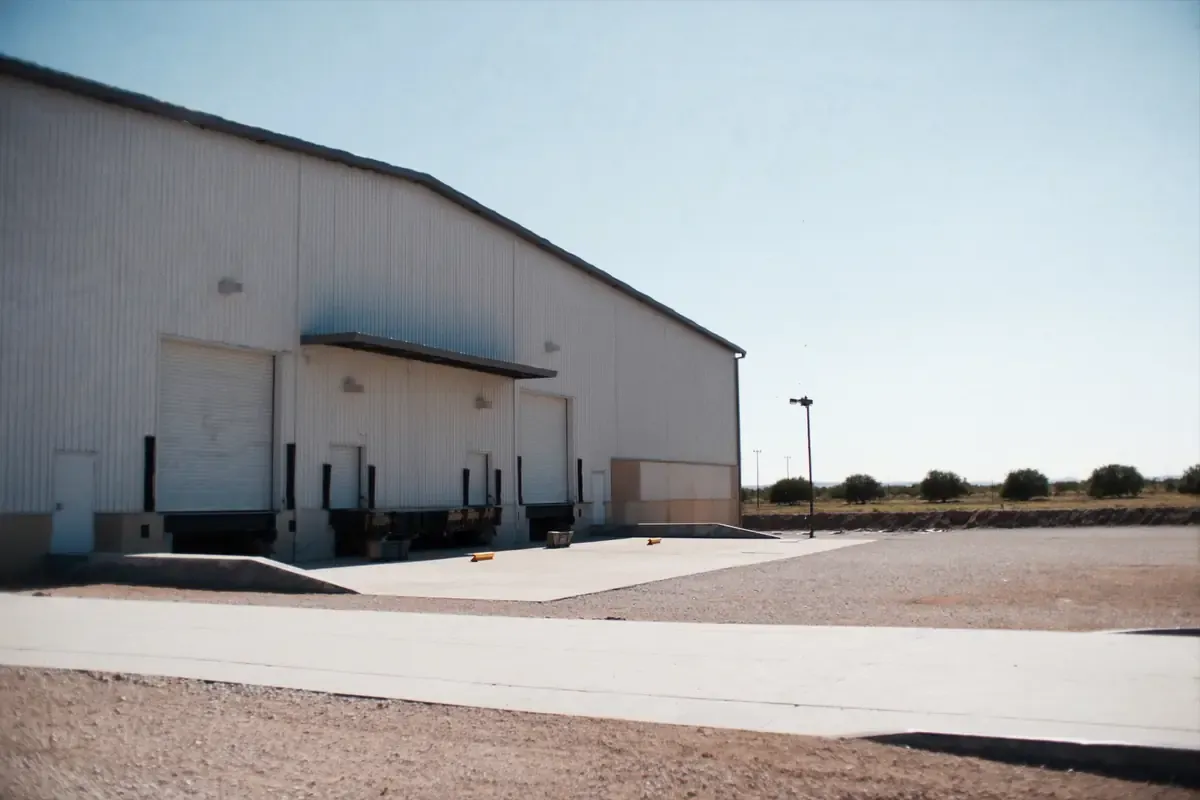
What makes a warehouse different from every other metal building?
The floor is the product. You move pallets, racks or vehicles through a volume, so span, aisle and doors get settled first. Clear span or column grid? A clear-span frame carries the roof wall to wall with nothing in the middle, which is what racking and forklifts want; a multi-span frame uses lighter steel for the same width, at the price of posts in the floor.
The slab is a second load problem. The frame drives its reactions into the column bases; the floor carries rack legs, forklift wheels and what you stack, so thickness, reinforcement and joints are designed to that loading.
The span also decides who signs the drawings. Occupations Code 1001.056 exempts from the engineering chapter, where no engineering services are offered to the public, a one-story building of not more than 5,000 square feet with no clear span greater than 24 feet on the narrow side. A warehouse clears both limits on the first sketch, and inside the City of San Antonio all structural sheets, the foundation and structural framing, must be stamped by a Texas professional engineer. The architect statute mostly stays out of the way: 1051.606 exempts plans for a privately owned commercial building no taller than two stories or larger than 20,000 square feet, and separately a warehouse with limited public access.
Source: Texas Legislature Online, Occupations Code Chapter 1001, engineers and engineering, read 2026-09-13.
Source: City of San Antonio Development Services, commercial project application guide, read 2026-09-13.
Source: Texas Legislature Online, Occupations Code Chapter 1051, architects, read 2026-09-13.
How tall, how many doors, and do you need a dock?
Work backward from the tallest thing you store and the tallest thing that drives in. Eave height sets stack height once you subtract what hangs below the frame: lights, heaters, fire protection, door tracks. Cheap at the order stage, a new building later.
Dock height is a dirt decision more than a steel one. A dock-height floor sits at the bed height of a trailer, so the slab and the apron finish at two elevations and the approach and drainage get designed with the pad. Grade-level drive-in doors are simpler ground work.
Overhead doors are framed openings, not accessories: number, size and position ride on the building order, because the jambs, headers and bracing are engineered in.
Who permits a warehouse here, and where does the fire code come in?
Outside city limits a county reaches a warehouse through one power, the fire code. Local Government Code 233.061 opens that door only to a county over 250,000 population or one next to it, 233.062 limits the code to a commercial establishment, a public building and a multifamily dwelling of four or more units while exempting an industrial facility with a fire brigade conforming to federal occupational safety requirements, and 233.063 bars construction without a county permit and occupancy until a certificate of compliance issues. Chapter 233 gives a county no general commercial building code.
Bexar County is the anchor. Its Fire Marshal Office, 210-335-0300, determines when building permits are required for structures not for single-family dwelling use, and that permit covers site clearing, so the pad is permitted before the first blade of dirt moves. The county is on the 2021 International Fire and Building Codes, effective January 1, 2024. The other six differ: four of the seven publish a county permit path for a non-residential building and three publish none on any page read, which is what those sites list rather than an exemption from a state rule. Each county page carries its own answer, indexed at the seven counties this site covers.
Inside San Antonio the city reviews it, and square footage buys no fast lane: storage, factory and high hazard occupancies are complex plans whatever their size, 18 calendar days for the initial technical review against eight business days on the minor-plan track. The fee runs off a valuation the city sets from International Code Council costs per square foot with an Army Corps of Engineers modifier. Add offices or a counter and it behaves like a commercial metal building.
Sprinklers and the occupancy classification live inside the adopted code, so take both to the fire marshal or city reviewer before the building is sized.
Statute read in full, no such county authority granted. Source: Texas Legislature Online, Local Government Code Chapter 233, county regulation of housing and other structures, read 2026-09-13.
Source: Bexar County, building permits and fire marshal code enforcement pages, read 2026-09-13.
Source: Bexar County Fire Marshal, code enforcement and inspections, read 2026-09-13.
Source: City of San Antonio Development Services, commercial project application guide, read 2026-09-13.
Source: City of San Antonio Development Services, FY 2026 development fee schedule, read 2026-09-13.
Does the $50,000 accessibility line reach a warehouse?
Assume it does until the design professional says otherwise. TDLR requires a project with a total estimated construction cost of $50,000 or more to be registered, with construction documents going to a registered accessibility specialist under Administrative Rule 68.50. Government Code 469.003 reaches a building meeting the federal Americans with Disabilities Act definition of a public accommodation on or after January 1, 1992, or of a commercial facility on or after September 1, 1993.
The sequence bites harder than the $175 filing fee. Section 469.102 bars the owner from applying for a local building permit or starting construction before the plans go to TDLR, and bars a local official from accepting the application without verifying the registration. Atascosa County says the same: its Fire Marshal office may refuse the application until the registration number and TDLR Form AB042 are supplied (Atascosa County Fire Marshal permit documents, read 2026-09-13).
Source: Texas Department of Licensing and Regulation, Architectural Barriers frequently asked questions, read 2026-09-13.
Source: Texas Legislature Online, Government Code Chapter 469, elimination of architectural barriers, read 2026-09-13.
Source: Texas Department of Licensing and Regulation, Architectural Barriers fee schedule, read 2026-09-13.
Source: Atascosa County Fire Marshal and Emergency Management Office, Permit and Inspection Process Overview, read 2026-09-13.
Stormwater and the aquifer plan run on acreage, and a warehouse pad is big
Construction that disturbs one acre or more and discharges stormwater to surface water in the state needs coverage under the TCEQ construction general permit, with a pollution prevention plan before work starts. At five acres or more the operator files a Notice of Intent through STEERS, $225 electronic or $325 paper; one to under five acres posts a signed site notice two days ahead instead. Bexar County adds a $500 storm water quality permit on the same trigger, which it recommends filing 45 days before the Permit Verification Form (Bexar County Public Works, read 2026-09-13).
North and west of San Antonio the aquifer plan is the longest clock on the job. TCEQ requires an approved Edwards Aquifer protection plan before construction begins on the recharge, transition or contributing zone, and names Bexar and Medina among the counties covered here. On the recharge zone that is a water pollution abatement plan for building, clearing or excavation; on the contributing zone the trigger is five acres. Technical review runs 90 calendar days after an administrative review that can take 30, and the fee runs from $3,000 for a non-residential project under one acre to $10,000.
| Soil disturbed | What TCEQ asks for | What Bexar County adds |
|---|---|---|
| Under one acre, not part of a larger plan of development or sale | No coverage under the construction general permit. | Nothing on this trigger. |
| One acre to under five | Coverage with no Notice of Intent: a signed site notice posted and copied to the storm sewer operator two days before work starts, with a pollution prevention plan in place first. | A storm water quality permit at $500, recommended 45 days before the Permit Verification Form. |
| Five acres or more | A Notice of Intent through STEERS first, $225 electronic or $325 paper, then a Notice of Termination within 30 days of stabilization. | The same $500 permit, first submittals 30 days and resubmittals 15. |
Source: Texas Commission on Environmental Quality, construction stormwater general permit TXR150000, read 2026-09-13.
Source: Texas Commission on Environmental Quality, general permit TXR150000, fees, read 2026-09-13.
Source: Texas Commission on Environmental Quality, Edwards Aquifer Protection Program, read 2026-09-13.
Source: Texas Commission on Environmental Quality, Edwards Aquifer Protection Program, what plans you might need, read 2026-09-13.
Source: Texas Commission on Environmental Quality, Edwards Aquifer application and review process, read 2026-09-13.
Source: Texas Commission on Environmental Quality, Edwards Aquifer application fee form TCEQ-0574, read 2026-09-13.
Source: Bexar County Public Works Department, Public Works Permits Verification Guidelines, read 2026-09-13.
Can a truck get in and turn around?
Settle it before the building is laid out: access is permitted separately and can move the footprint. A new or revised driveway onto a state highway goes to the local TxDOT district office on Form 1058, and no work starts on the right of way until the permit is fully executed and TxDOT has had 24 hours notice. The San Antonio district, 210-615-1110, covers six of the seven counties here; Karnes sits in another district.
On a county road the county usually issues it, and the office, the fee and the geometry differ by county line. One publishes geometry that constrains a site plan: Atascosa County spaces commercial driveways at least 60 feet apart, 120 feet on major thoroughfares, allows no more than one on a commercial tract with 95 feet or less of frontage, and sets a 300-foot sight requirement (Atascosa County driveway standards adopted June 25, 2018, read 2026-09-13). County offices and fees are in TxDOT and county driveway access.
Source: Texas Department of Transportation, access management manual, driveway permits, read 2026-09-13.
Source: Texas Department of Transportation, San Antonio District, read 2026-09-13.
Source: Atascosa County, Comprehensive Fee Schedule and Commercial Driveway Standards and Permitting Process, read 2026-09-13.
Septic, water and power are lead-time items on a rural lot
Septic first, because the state rules do not treat a warehouse as a house. TCEQ defines a commercial or institutional facility as any building not used as a single-family dwelling or duplex, and 30 TAC 285.5 requires a professional engineer or sanitarian to seal the planning materials for non-standard treatment or disposal and for all new construction in the Edwards Aquifer recharge zone. The permit comes before installation, and every county here has its own authorized agent, so TCEQ is not the office. Power is scheduling, not a hookup:
CPS Energy splits commercial customers at 300 KVA of diversified load: below it, small commercial on overhead transformers; at or above, large commercial on a pad-mounted transformer, and it publishes about 15 business days to set that transformer.
Medina Electric Cooperative names industrial warehouses as commercial, takes a non-refundable $100 engineering fee before the site visit, asks for 40 feet of cleared right of way, and normally takes four to six weeks once a job goes to construction. Guadalupe Valley Electric asks three to five weeks from the request for a new service at a newly constructed location, and charges developers and builders a $6,000 engineering deposit before design, against the development application, master plan, unit plat, utility plans and civil construction plans it asks them for.
Source: Texas Commission on Environmental Quality publication RG-472, on-site sewage facility rules compilation, read 2026-09-13.
Source: Texas Commission on Environmental Quality, getting a permit for an on-site sewage facility, read 2026-09-13.
Source: Texas Commission on Environmental Quality, On-Site Activity Reporting System, authorized agent search by county, records read for Bexar, Medina, Wilson, Atascosa, Guadalupe, Karnes and Frio, read 2026-09-13.
Source: CPS Energy, new commercial construction, read 2026-09-13.
Source: Medina Electric Cooperative, start or stop service, read 2026-09-13.
Source: Guadalupe Valley Electric Cooperative, developer and builder resources, read 2026-09-13.
Who a warehouse fits, who does the work, and what to put in the estimate
It fits an owner with inventory, equipment or a production line that has to be enclosed, secured and worked in year round, on ground that takes truck traffic. It is the wrong building for parking: a roof over ranch equipment, trailers or a fleet that never comes indoors is cheaper open-sided, and that is equipment and RV storage buildings. One or two bays for your own trucks is a shop. The order the project runs in is on building a metal building in San Antonio.
Two numbers decide whether a warehouse price means anything: the floor loading the slab is designed for and the door schedule. An independent local metal building contractor serving the San Antonio area prices the building off those, orders the package, handles or subcontracts the site work and concrete, and erects the frame, and a Texas professional engineer seals the structural drawings. Texas licenses no home builder or general contractor, so that seal and the electrical, plumbing and air conditioning licenses are the credentials to ask about.
Get in writing: the span, eave height and bay spacing assumed; the door schedule; the floor loading the slab is designed for; who files the TDLR registration, the permit, the stormwater notice and the aquifer plan; and what is excluded, especially utility extensions and the apron. No company serving this footprint publishes a warehouse price, and a building sized to your racking and your trucks is not a catalog item, so the number comes from the contractor who walks the property.
Source: Sunset Advisory Commission, Texas Residential Construction Commission; TDLR regulated industries list, read 2026-09-13.
Price pages read, no figure published. Source: Four San Antonio-area metal building company websites, read 2026-09-13.
Questions people ask
Who permits a metal warehouse outside San Antonio city limits?
In unincorporated Bexar County the Fire Marshal Office at 210-335-0300 determines when building permits are required for structures not for single-family dwelling use, and that permit covers site clearing as well as construction. The county adopted the 2021 International Fire and Building Codes effective January 1, 2024. Outside Bexar the answer changes with the county line: Local Government Code 233.061 lets only a county with a population over 250,000, or one adjacent to such a county, adopt a fire code, and 233.062 limits that code to a commercial establishment, a public building or a multifamily dwelling of four or more units, exempting an industrial facility with a fire brigade conforming to federal occupational safety requirements. Read at bexar.org and Texas Legislature Online, 2026-09-13.
Does a warehouse in Texas need an architect?
Not under the architect statute, for a privately owned one. Occupations Code 1051.606 exempts a person who does not hold out as an architect for plans for a privately owned commercial building that does not exceed two stories or 20,000 square feet, and separately for a warehouse that has limited public access. Section 1051.703 requires an architect for new public-entity buildings costing more than $100,000 used for education, assembly or office occupancy. The engineering question is separate: inside the City of San Antonio, all structural sheets, the foundation and structural framing, must be stamped by a Texas professional engineer. Read at Texas Legislature Online and the City of San Antonio commercial project application guide, 2026-09-13.
How long does an Edwards Aquifer plan take before a warehouse pad can be graded?
TCEQ schedules the administrative review two weeks from submission and it can take up to 30 days, technical review then has 90 calendar days, and construction may not begin until the approval is issued. An approved plan is required before construction begins on the recharge, transition or contributing zone, and in this region the program names Bexar, Medina, Comal, Uvalde and Kinney counties, with only portions of the aquifer regulated. The fee is set by the acreage of the whole property and the type of development, minimum $650 and maximum $10,000; a non-residential project, which TCEQ defines to include commercial and industrial sites, pays $3,000 under one acre. Read at tceq.texas.gov, 2026-09-13.
Does a warehouse project need TDLR registration at $50,000?
A project with a total estimated construction cost of $50,000 or more must be registered with the Texas Department of Licensing and Regulation, with construction documents going to a registered accessibility specialist for review under Administrative Rule 68.50, and the project filing fee is $175. Government Code 469.102 bars the owner from applying for a local building permit or starting construction before the plans are submitted, and bars a local permitting official from accepting the application unless the official verifies the registration. Whether a building is covered turns on Government Code 469.003, which reaches a building meeting the federal Americans with Disabilities Act definition of a public accommodation or of a commercial facility. Read at tdlr.texas.gov and Texas Legislature Online, 2026-09-13.