
Covered courts and indoor pickleball buildings in San Antonio, Texas
A covered court is a steel frame and a roof over a playing surface with the sides left open. An indoor pickleball building is that frame closed in, lit and conditioned, so the courts play in August and in a norther.
Read the rest
The slab is the court, not just a floor. An independent local metal building contractor serving the San Antonio area prices the court and puts the building up.
- Sheet
- Service
- Jurisdiction
- Seven counties, TX
- Reviewed
- 2026-09-13
- Sources
- 22 primary sources
Ready to build? An independent local contractor who works your county prices the building. The estimate costs you nothing, now or later, whatever you decide.
Covered court or conditioned court: which one are you building?
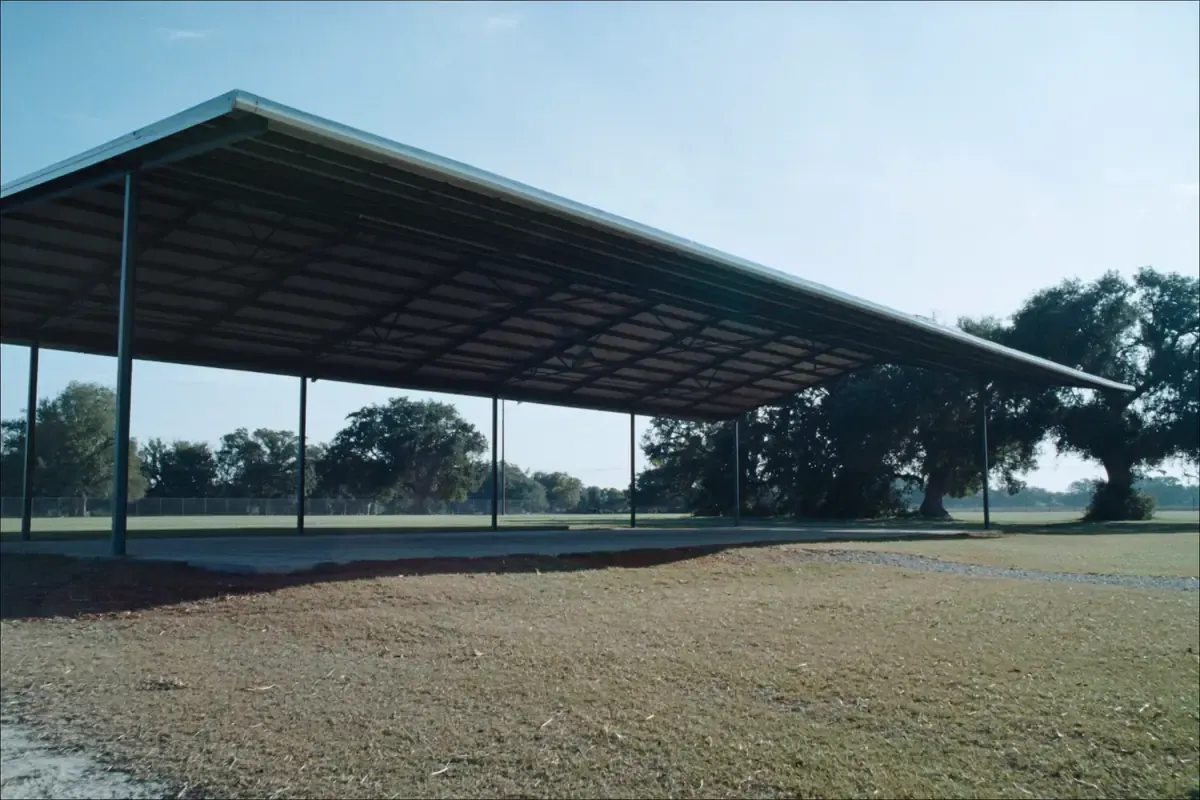
Settle this first: it changes the frame, the floor, the utilities and the review. A covered court is columns, a roof and open sides. It takes sun, hail and rain off the surface for the least money per square foot, and leaves the wind and the July heat. A conditioned court closes and insulates the walls, lights and cools the space, and turns the same footprint into a building people stay in.
Conditioning pulls the energy code in. The State Energy Conservation Office states the 2015 International Energy Conservation Code is the adopted Texas energy code for commercial construction, effective November 1, 2016. Outside a municipality, Health and Safety Code 388.004 accepts certification by an accredited program or private code-certified inspectors, and otherwise the builder certifies on a form.
Court count sets the footprint, and the footprint is what gets ordered: fix the number of courts and the run-off around them before anyone quotes steel.
| What changes | Covered court | Conditioned court building |
|---|---|---|
| The shell | Columns, a roof, open sides. | Walls closed in and insulated, with doors in the order. |
| What it keeps out | Sun, hail and rain. Wind and July heat come through. | Weather, wind and heat, at the cost of lighting and cooling the volume. |
| The energy code | Nothing is heated or cooled, so the energy code question belongs to the column on the right. | The 2015 International Energy Conservation Code, the adopted Texas energy code for commercial construction, effective November 1, 2016. |
| Who certifies it outside a city | The same answer, once anything is conditioned. | Health and Safety Code 388.004 accepts certification by an accredited program or private code-certified inspectors, and otherwise the builder certifies on a form. |
Source: Texas Comptroller of Public Accounts, State Energy Conservation Office, commercial construction energy code, read 2026-09-13.
Source: Texas Legislature Online, Health and Safety Code Chapter 388, building energy efficiency performance standards, read 2026-09-13.
What does the slab under an indoor pickleball building have to do?
Two jobs, and the second is unusual. The frame drives its reactions into the column bases, so the foundation is poured to the anchor bolt plan in the package. The same concrete then has to hold a flat, level plane across the playing area, because a ball reads every dip a forklift ignores.
Control joints are where owners get caught. Concrete is jointed so it cracks where someone chose, and a joint through a playing area is a seam a ball crosses at speed. The concrete is not the finished court either: an acrylic or cushioned surfacing system goes over it, with its own conditions for cure time, slab moisture and texture. Settle both with the court layout in front of you, before the pour.
The ground decides what flatness costs. The Guadalupe County survey rates its Houston Black-Heiden uplands, about 22 percent of the county, as very high shrink-swell (Soil Survey of Guadalupe County, Texas, USDA Soil Conservation Service, 1977, read 2026-09-13), while northern Bexar and Medina are shallow soil over hard limestone.
Source: USDA Soil Conservation Service, Soil Survey of Guadalupe County, Texas (1977), read 2026-09-13.
Source: USDA Soil Conservation Service, Soil Survey of Bexar County, Texas (1966), read 2026-09-13.
Clear height and lighting are ordered with the frame, not added later
No Texas rule this site can cite sets a court height, so treat it as a design input, not a code number. What matters is the clear height to the underside of the lowest thing over the court: light fixtures, frame bracing, duct runs, door tracks. The rule book for the sport and the lighting layout set it, and eave height is cheap at the order stage and a second building later.
Lights hang off the frame, so their weight and mounting points ride on the building order, and a court is played with heads up, so aiming and shielding matter more than in a shop. That load decides how the power arrives: CPS Energy designates a customer under 300 KVA of diversified load as small commercial on overhead transformers, and 300 KVA or larger as large commercial on a pad-mounted transformer, which it publishes about 15 business days to set.
Source: CPS Energy, new commercial construction, read 2026-09-13.
Who seals the drawings, and who reviews them?
An engineer, on the span alone. Occupations Code 1001.056 keeps its exemption from the engineering chapter narrow, and only where no engineering services are offered to the public: one story, 5,000 square feet or less, no clear span greater than 24 feet on the narrow side. One court plus its surround passes 24 feet before a second is drawn. Inside the City of San Antonio all structural sheets, the foundation and structural framing, must be stamped by a Texas professional engineer.
Who reviews it is your address. In San Antonio, square footage buys no fast lane once people gather to watch: assembly occupancies are complex plans whatever their size, 18 calendar days for the initial technical review against eight business days on the minor plan track. Outside a city the answer changes at the county line: the seven counties.
Source: Texas Legislature Online, Occupations Code Chapter 1001, engineers and engineering, read 2026-09-13.
Source: City of San Antonio Development Services, commercial project application guide, read 2026-09-13.
What does the $50,000 accessibility line do to a court open to the public?
It changes the order the project runs in, which costs more than the fee. Under Administrative Rule 68.50, a project whose total estimated construction cost reaches $50,000 has to be registered with TDLR, and a full set of construction documents goes to a registered accessibility specialist. Coverage turns on Government Code 469.003, which reaches a building meeting the federal Americans with Disabilities Act definition of a public accommodation or a commercial facility. A club selling court time is that case.
The sequence is what stops a job. Government Code 469.102 bars the owner from applying for a local building permit or starting construction before the plans go to TDLR, and bars a local official from accepting the application without verifying the registration. The filing fee is $175, and the specialist sets a separate fee TDLR publishes no amount for.
What counts toward the $50,000 leaves out site acquisition, design fees and furnishings, so nets and loose seating are worth asking about. San Antonio does not run this review and sends a project valued over $50,000 to TDLR: TDLR registration for a project over $50,000.
Source: Texas Department of Licensing and Regulation, Architectural Barriers frequently asked questions, read 2026-09-13.
Source: Texas Legislature Online, Government Code Chapter 469, elimination of architectural barriers, read 2026-09-13.
Source: Texas Department of Licensing and Regulation, Architectural Barriers fee schedule, read 2026-09-13.
Source: Texas Department of Licensing and Regulation, Architectural Barriers special project registration application, read 2026-09-13.
Source: City of San Antonio Development Services, commercial project application guide, read 2026-09-13.
Is a covered court at your own house treated the same way?
Not while it stays private. TDLR puts the architectural barriers law and the Texas Accessibility Standards on public and commercial buildings, not on private residences, and the 2012 standards reach only the portions of a residence used in operating a business, so charging for court time crosses that line. Over the aquifer a home court meets a different number: TCEQ counts rooftops, driveways, concrete pads and sidewalks as impervious cover, and one case where a homeowner may not need an individual protection plan is holding it at or under 20 percent of the lot.
Source: Texas Department of Licensing and Regulation, elimination of architectural barriers at a glance, read 2026-09-13.
Source: Texas Department of Licensing and Regulation, 2012 Texas Accessibility Standards, scoping requirements, read 2026-09-13.
Source: Texas Commission on Environmental Quality, Edwards Aquifer private residences, read 2026-09-13.
The parking, the aquifer plan and the restrooms
A club is a parking problem as much as a building. Three filings run on that dirt:
Stormwater. Disturbing one acre or more and discharging to surface water in the state takes coverage under the TCEQ construction general permit, and a pollution prevention plan first. One to under five acres posts a signed site notice two days ahead; five acres or more files a Notice of Intent through STEERS, $225 electronic or $325 paper.
The aquifer, in Bexar and Medina. TCEQ requires an approved Edwards Aquifer protection plan before construction begins on the recharge, transition or contributing zone, and on the recharge zone it covers buildings, roads, clearing and excavation, so it reaches the pad and the parking. Administrative review can take 30 days and technical review 90.
Septic. Restrooms on a lot with no sewer make it a commercial permit: the rules count any building that is not a single-family dwelling or duplex as commercial, and 30 TAC 285.5 makes an engineer or sanitarian seal the planning materials in the recharge zone.
Source: Texas Commission on Environmental Quality, construction stormwater general permit TXR150000, read 2026-09-13.
Source: Texas Commission on Environmental Quality, general permit TXR150000, fees, read 2026-09-13.
Source: Texas Commission on Environmental Quality, Edwards Aquifer Protection Program, read 2026-09-13.
Source: Texas Commission on Environmental Quality, Edwards Aquifer Protection Program, what plans you might need, read 2026-09-13.
Source: Texas Commission on Environmental Quality, Edwards Aquifer application and review process, read 2026-09-13.
Source: Texas Commission on Environmental Quality publication RG-472, on-site sewage facility rules compilation, read 2026-09-13.
Who a court building fits, who it does not, and what to get in writing
It fits an owner whose play stops when the weather does: a club selling court time, a school or congregation adding a gym-sized space, a family with the acreage for one. Where you want assembly space with a stage and a kitchen rather than a marked court, that is church and community buildings. Where an open roof is the whole brief, price it against pole barns and post-frame buildings: posts in the ground carry a simple roof for less than red iron.
The surfacing system is what makes this a court rather than a shed, and it sets conditions on the concrete before anyone can quote the job: cure time, slab moisture, texture, and where the joints fall around the playing area. An independent local metal building contractor serving the San Antonio area quotes the building against those, orders the package, runs or subcontracts the dirt work and the slab, and stands the frame up. Texas licenses no home builder or general contractor, so the license numbers to ask for belong to the electrician and the plumber.
Get in writing: the court count and run-off; the clear height under the lights; where the joints fall; whether surfacing is in scope; and who files the TDLR registration, the permit, the stormwater notice and the aquifer plan. No company here publishes a price, and the court count, the run-off and the surfacing conditions move the number, so it is quoted to your layout. Project order: building a metal building in San Antonio.
Source: Sunset Advisory Commission, Texas Residential Construction Commission; TDLR regulated industries list, read 2026-09-13.
Price pages read, no figure published. Source: Four San Antonio-area metal building company websites, read 2026-09-13.
Questions people ask
Does an indoor pickleball building need TDLR registration at $50,000 in Texas?
Yes, once the total estimated construction cost reaches $50,000. Administrative Rule 68.50 has the project registered with the Texas Department of Licensing and Regulation, a full set of construction documents sent to a registered accessibility specialist, and a $175 filing fee paid. Coverage turns on Government Code 469.003, which reaches a building meeting the federal Americans with Disabilities Act definition of a public accommodation or of a commercial facility, so a court rented by the hour is the case to check. Read at tdlr.texas.gov and Texas Legislature Online, 2026-09-13.
Is a covered court at a private residence covered by the Texas Accessibility Standards?
No, while it stays private. TDLR says the elimination of architectural barriers law and the Texas Accessibility Standards are written for public and commercial buildings and facilities, and do not apply to private residences. The 2012 Texas Accessibility Standards set the limit: where a commercial facility or public accommodation is located in a private residence, the portion used exclusively as a residence is not covered, and the portions used in operating the business are. Read at tdlr.texas.gov, 2026-09-13.
Who permits a covered court outside the city limits in Bexar County, TX?
The Bexar County Fire Marshal Office at 210-335-0300. In unincorporated Bexar County that office determines when building permits are required for structures or areas that are not for single-family dwelling use, and the permit covers site clearing as well as construction. The county has 30 days to issue or deny, and the permit is valid 180 days from issuance. Read at bexar.org, 2026-09-13.
Does a pickleball court building need an architect in Texas?
Often not for a privately owned one, but a large footprint crosses the line. Occupations Code 1051.606 exempts a person who does not hold out as an architect for plans for a privately owned commercial building that does not exceed two stories or 20,000 square feet, and a multi-court building with a lobby and restrooms can pass that. Engineering is harder to avoid: Occupations Code 1001.056 exempts only a one-story building of 5,000 square feet or less with no clear span over 24 feet. Read at Texas Legislature Online, 2026-09-13.