
Equipment and RV storage buildings in San Antonio, Texas
An equipment storage building is a steel frame over your machinery: open-sided to cover the most ground for the money, or enclosed where the contents need walls and a lock. An RV storage building is the same frame, tall and deep enough for coaches.
Read the rest
An independent local metal building contractor serving the San Antonio area prices it and builds it.
- Sheet
- Service
- Jurisdiction
- Seven counties, TX
- Reviewed
- 2026-09-13
- Sources
- 22 primary sources
Ready to build? An independent local contractor who works your county prices the building. The estimate costs you nothing, now or later, whatever you decide.
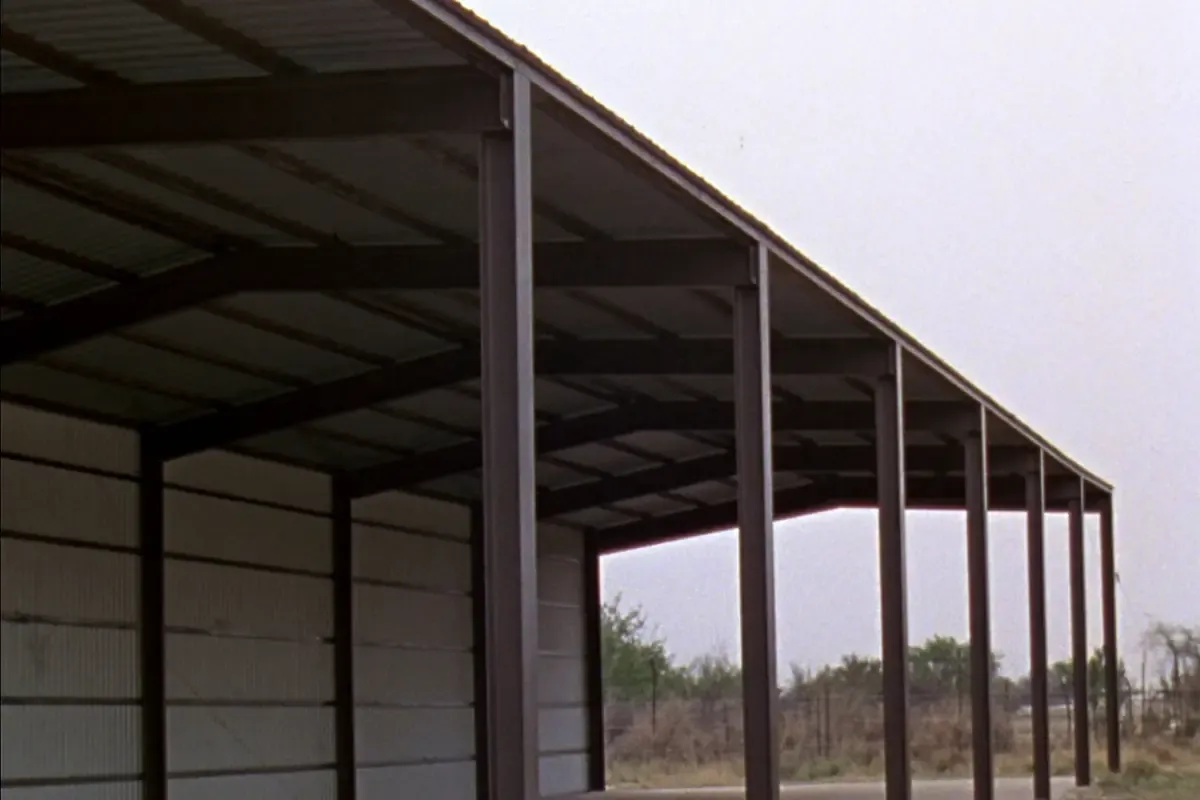
Open-sided or enclosed: which equipment storage building fits?
Start with what you are keeping the weather off. Sun, hail and rain take an open-sided cover: columns, a roof, and as many bays as the ground allows, at the lowest cost per square foot here. Theft, dust and anything with upholstery or wiring takes walls and a door. Most working places land in between, three sides closed and the open side turned from the weather.
Size it off the longest and tallest thing you own, loaded. Doors are framed openings engineered into the order, so the door schedule is settled before the steel is punched.
Gravel, caliche or a slab under the bays?
Not every bay needs concrete, and on a ranch most do not. Compacted gravel or caliche drains and takes tracked equipment for less. Concrete is what a machine you jack up, a wash bay or a coach parked all year calls for. Split it where the uses split.
The pad is the part that fails quietly: built up, compacted and drained so water leaves instead of standing at the column bases. The dirt changes by county: the Hindes soils in Atascosa County formed over beds of caliche, and the unit under about 25 percent of that county is limited by shrinking and swelling, corrosivity to uncoated steel and low soil strength (Soil Survey of Atascosa County, Texas, USDA Soil Conservation Service, 1980, read 2026-09-13). See pad grading and site prep.
Source: USDA Soil Conservation Service, Soil Survey of Atascosa County, Texas (1980), read 2026-09-13.
Does a ranch storage building need an engineer to seal the drawings?
Often not, which is unusual for a building this size. Occupations Code 1001.056 exempts from the engineering chapter, where no engineering services are offered to the public, a private building used exclusively for farm, ranch or agricultural purposes or for storing raw agricultural commodities. It also exempts a one-story building of 5,000 square feet or less with no clear span over 24 feet on the narrow side, and where such a building spans longer, only the roof supporting members must be engineered or pre-engineered.
Read the word exclusively. A building that also holds a contractor fleet, a rented bay or business inventory is outside it, and a county reviewer, a lender or the manufacturer can ask for a sealed foundation plan anyway.
Source: Texas Legislature Online, Occupations Code Chapter 1001, engineers and engineering, read 2026-09-13.
Who permits a storage building outside the city limits?
Your address decides, and the county power is narrow. Local Government Code Chapter 233 gives a county no general commercial building code. Its one power reaching a building like this is a fire code, open only to a county over 250,000 population or one next to such a county, and limited to a commercial establishment, a public building or a multifamily dwelling of four or more units.
In unincorporated Bexar County the Fire Marshal Office at 210-335-0300 determines when building permits are required for structures not for single-family dwelling use, and that permit covers site clearing, so the clearing is permitted before the pad is cut. The other six answer for themselves: Karnes County publishes special projects, septic and road and bridge permits and names no building permit on any page read (Karnes County permitting pages, read 2026-09-13). That is what the site lists, not a tract with no rules; confirm at 830-780-3511. Answers by county: the seven counties.
Statute read in full, no such county authority granted. Source: Texas Legislature Online, Local Government Code Chapter 233, county regulation of housing and other structures, read 2026-09-13.
Source: Bexar County, building permits and fire marshal code enforcement pages, read 2026-09-13.
Source read, the item described is not listed. Source: Karnes County, Special Projects and Permits, read 2026-09-13.
Aquifer plan and stormwater: the filings that gate the dirt work
On the north side of Bexar and Medina counties, clearing sits inside the aquifer rule rather than ahead of it. TCEQ requires an approved Edwards Aquifer protection plan before construction begins on the recharge, transition or contributing zone. On the recharge zone that plan covers buildings, roads, clearing and excavation, so the pad and the ranch road are in it; on the contributing zone the trigger is five acres disturbed. Only portions are regulated; the TCEQ map viewer settles a tract. Allow for the clock: up to 30 days of administrative review, then 90 calendar days of technical review, and no work may begin until approval issues.
Stormwater runs on acreage instead of zones, and a long building with its drive and turnaround crosses an acre fast. One acre or more disturbed, discharging to surface water in the state, takes coverage under the TCEQ construction general permit and a pollution prevention plan first.
One to under five acres: no Notice of Intent, a signed site notice posted and copied to the storm sewer operator two days before work begins.
Five acres or more: a Notice of Intent through STEERS first, $225 electronic or $325 paper, then a Notice of Termination within 30 days of stabilization.
Neither releases a site over the aquifer: construction may not begin until TCEQ approves the protection plan.
Source: Texas Commission on Environmental Quality, Edwards Aquifer Protection Program, read 2026-09-13.
Source: Texas Commission on Environmental Quality, Edwards Aquifer Protection Program, what plans you might need, read 2026-09-13.
Source: Texas Commission on Environmental Quality, Edwards Aquifer application and review process, read 2026-09-13.
Source: Texas Commission on Environmental Quality, construction stormwater general permit TXR150000, read 2026-09-13.
Source: Texas Commission on Environmental Quality, general permit TXR150000, fees, read 2026-09-13.
The driveway onto a county road is its own permit
Equipment arrives on a trailer, so settle access before the building is placed. A new or revised driveway onto a state highway goes to the local TxDOT district office on Form 1058, and no work starts on the right of way until the permit is executed and TxDOT has had 24 hours notice. The San Antonio district, 210-615-1110, covers six of these counties; Karnes is in another.
On a county road the county issues it, and one prices it by use: Wilson County charges $750.00 for a commercial driveway of 24 to 100 feet and $250.00 for a residential and agriculture driveway of 12 to 24 feet (Wilson County, Fees for Applications for Permits, read 2026-09-13). Frio County is the gap. No driveway permit and no culvert permit appears on the county site, so call Road and Bridge at 830-505-7402 first (Frio County, County Engineer and Road and Bridge Department, read 2026-09-13).
| Where the drive lands | Who permits it | What the office publishes |
|---|---|---|
| A state highway | The local TxDOT district office, on Form 1058 | No work on the right of way until the permit is executed and TxDOT has had 24 hours notice. The San Antonio district, 210-615-1110, covers six of these seven counties; Karnes sits in another. |
| A county road in Wilson County | Wilson County Permitting and Development, 830-393-8357, under the PIPROW permit | $750.00 for a commercial driveway of 24 to 100 feet, $250.00 for a residential and agriculture driveway of 12 to 24 feet, and $100.00 for a temporary or construction drive, credited to the permanent one. |
| A county road in Frio County | Frio County Road and Bridge, 830-505-7402 | No driveway permit and no culvert permit appears on the county site. The county prices road crossings in the utility and pipeline context only. |
Source: Texas Department of Transportation, access management manual, driveway permits, read 2026-09-13.
Source: Texas Department of Transportation, San Antonio District, read 2026-09-13.
Source: Wilson County, Fees for Applications for Permits Issued by Wilson County, read 2026-09-13.
Source read, the item described is not listed. Source: Frio County, County Engineer and Road and Bridge Department, read 2026-09-13.
Does renting bays or adding a restroom change the rules?
Both do. TDLR requires a project with a total estimated construction cost of $50,000 or more to be registered, with construction documents going to a registered accessibility specialist under Administrative Rule 68.50, and Government Code 469.003 reaches a building meeting the federal Americans with Disabilities Act definition of a public accommodation or a commercial facility. Take rented bays to the design professional first. The standards do not apply to private residences, where your own equipment at your own house sits.
A restroom, an office or a wash bay makes septic a permit rather than a plumbing line. The rules count any building that is not a single-family dwelling or duplex as commercial, and 30 TAC 285.5 makes an engineer or sanitarian seal the planning materials for new construction in the Edwards Aquifer recharge zone. The 10 acre exemption is written for a single family dwelling alone on its tract, so it does not carry over. Every county here has its own authorized agent.
Source: Texas Department of Licensing and Regulation, Architectural Barriers frequently asked questions, read 2026-09-13.
Source: Texas Legislature Online, Government Code Chapter 469, elimination of architectural barriers, read 2026-09-13.
Source: Texas Department of Licensing and Regulation, elimination of architectural barriers at a glance, read 2026-09-13.
Source: Texas Commission on Environmental Quality publication RG-472, on-site sewage facility rules compilation, read 2026-09-13.
Source: Texas Commission on Environmental Quality, getting a permit for an on-site sewage facility, read 2026-09-13.
Source: Texas Commission on Environmental Quality, On-Site Activity Reporting System, authorized agent search by county, records read for Bexar, Medina, Wilson, Atascosa, Guadalupe, Karnes and Frio, read 2026-09-13.
Who this building fits, and what to get in writing
It fits an owner with more iron than cover: a rancher with implements and trailers in the sun, a contractor parking a fleet, a family with a coach on acreage. It is wrong in three cases. One vehicle at the house, in town, is detached garages and RV garages. A building you work inside is a shop. Where posts suit the ground and the budget better than red iron, price it against pole barns and post-frame buildings.
Two answers move this price more than the square footage does: how many sides close, and what the floor is in each bay. An independent local metal building contractor serving the San Antonio area prices the building off those, orders the package, handles or subcontracts the dirt work and concrete, and erects the frame. Texas licenses no home builder or general contractor, so the license numbers to ask for belong to the electrician and plumber.
Get in writing: bay width, clear height and how many sides close; the door schedule; the floor in each bay; who cuts and compacts the pad; who applies for the driveway and building permits and any aquifer or stormwater filing. No company serving this area publishes a price, so a quote comes off your bay count, your floors and the ground the pad sits on. Build order: building a metal building in San Antonio.
Source: Sunset Advisory Commission, Texas Residential Construction Commission; TDLR regulated industries list, read 2026-09-13.
Price pages read, no figure published. Source: Four San Antonio-area metal building company websites, read 2026-09-13.
Questions people ask
Do I need a permit for an RV storage building in Bexar County, TX?
Outside the city limits, call the Bexar County Fire Marshal Office at 210-335-0300 before ordering steel. In unincorporated Bexar County that office determines when building permits are required for structures or areas not for single-family dwelling use, which the county defines as a structure of three or fewer dwelling units, and the permit covers site clearing as well as construction. The county has 30 days to issue or deny and the permit is valid 180 days. Read at bexar.org, 2026-09-13.
Does an equipment storage building on a ranch need an engineer in Texas?
Often not. Occupations Code 1001.056 exempts from the engineering chapter, where no engineering services are offered to the public, a private building used exclusively for farm, ranch or agricultural purposes or for storing raw agricultural commodities. It also exempts a one-story building of 5,000 square feet or less with no clear span greater than 24 feet on the narrow side, and where such a building spans longer, only the roof supporting members must be engineered or pre-engineered. A building holding a business fleet or rented bays is outside the exemption. Read at Texas Legislature Online, 2026-09-13.
Does an open-sided storage building need a concrete floor?
That is a use decision, not a rule this site can cite. Gravel or caliche drains and takes tracked equipment; concrete is what a machine you jack up, a wash bay or a parked coach calls for. Either way the frame lands on anchor bolts set to the column reactions, so the footings are designed whatever the floor is. Concrete counts over the Edwards Aquifer: TCEQ counts rooftops, driveways, concrete pads, sheds and sidewalks as impervious cover, and one case where a homeowner may not need an individual protection plan is holding it at or under 20 percent of the lot. Read at tceq.texas.gov, 2026-09-13.
Does an Edwards Aquifer plan cover clearing and the pad in Bexar or Medina County, TX?
Yes on the recharge zone, so it comes before the dirt work. TCEQ requires an approved Edwards Aquifer protection plan before construction begins on the recharge, transition or contributing zone, and on the recharge zone the plan covers buildings, roads, clearing, excavation and any activity that alters the existing recharge characteristics of a site. On the contributing zone a plan is needed only where the activity disturbs at least five acres or is part of a larger plan of development. Only portions of the aquifer are regulated. Read at tceq.texas.gov, 2026-09-13.